
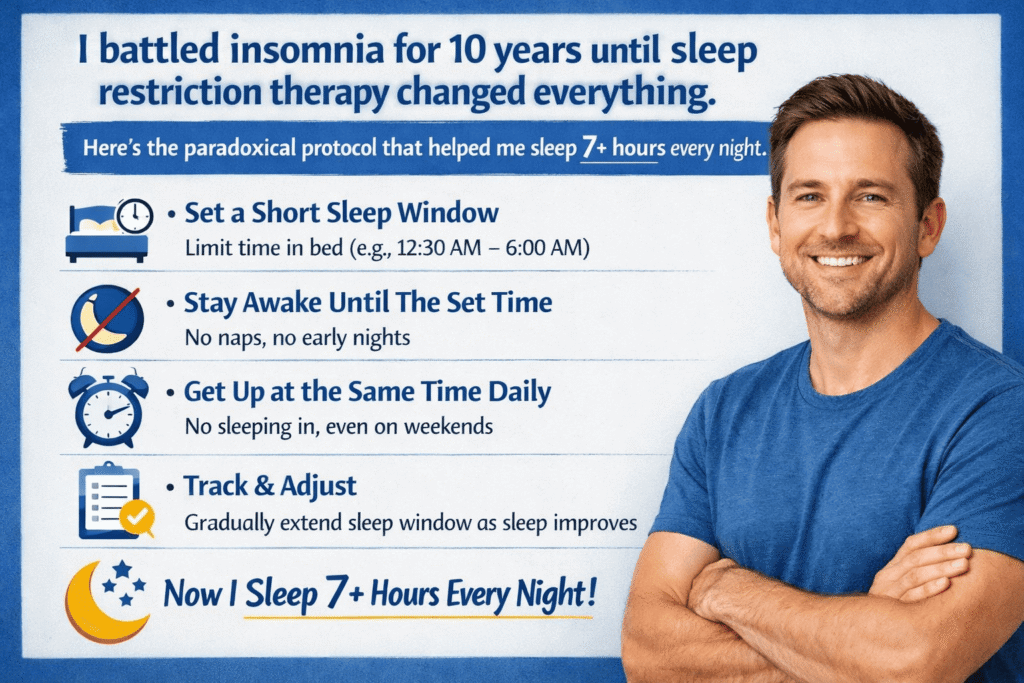
A 10-year battle with insomnia taught me that everything I knew about sleep was backwards
The Breaking Point
It was 3:47 AM when I found myself Googling “Is it possible to die from sleep deprivation?” for the third time that week.
I’d been awake for 23 hours straight. Again.
My bedroom had become a torture chamber. I’d tried everything the internet promised would work: blackout curtains ($200), a white noise machine ($80), magnesium supplements ($30/month), melatonin in every dosage, meditation apps, sleep trackers that told me what I already knew — I wasn’t sleeping.
The worst part? I was spending 9-10 hours in bed every night, desperately trying to “catch up” on sleep. My doctor had told me to “relax” and “give my body time to rest.”
I was doing exactly that. And it was destroying me.
The Advice That Sounded Insane
After yet another sleepless night, I dragged myself to see Dr. S.K. Majhi, a behavioral sleep medicine specialist. I expected her to prescribe sleeping pills or send me for another sleep study.
Instead, she said something that made me think she’d lost her mind:
“You need to sleep less.”
I stared at her. “I’m getting 4 hours of broken sleep. You want me to sleep… less?”
“Not less sleep,” she clarified. “Less time in bed. Much less.”
She explained that I had conditioned my brain to associate my bed with being awake. Every hour I spent tossing and turning was training my nervous system that beds are for anxiety, not sleep.
Her prescription was brutal:
Sleep Restriction Therapy.
- Go to bed at 1 AM (no earlier)
- Wake up at 6 AM (no matter what)
- No napping
- No lying down during the day
- Stay out of the bedroom entirely except for sleep
“You’re going to feel terrible for about a week,” she warned. “But your brain will recalibrate. It’ll learn that bed means sleep, period.”
I thought she was crazy. But I was desperate enough to try.
Week 1: Descent Into Hell
The first three days were genuinely the worst of my life.
I was getting maybe 3.5 hours of fragmented sleep, plus I was now forcing myself to stay awake until 1 AM even when I felt tired at 10 PM.
By day 4, I was hallucinating. Not dramatic hallucinations — just seeing movement in my peripheral vision that wasn’t there. Forgetting words mid-sentence. Nearly falling asleep at a red light.
I called Dr. Chen in a panic. “This is making it worse!”
“Your sleep efficiency is still below 80%,” she said, checking my sleep log. “Trust the process. Your brain is fighting you because change is uncomfortable. But it’s working.”
Working? I felt like a zombie.
But then, on night 7, something shifted.
The Breakthrough
I went to bed at 1 AM, exhausted as usual. But instead of the familiar dread, I felt… sleepy. Actually sleepy. The kind of sleepy where your eyelids feel heavy, not the anxious “I should be sleeping” feeling I’d had for years.
I fell asleep in 12 minutes.
I woke up once at 4 AM, but instead of spiraling into anxiety, I fell back asleep within 20 minutes.
My alarm went off at 6 AM.
I had slept — truly slept — for approximately 6 hours.
I cried in the shower that morning. Six hours of sleep felt like a miracle.
The Science Behind the Paradox
Here’s what I learned about why this works (and why everything I’d been doing before was making it worse):
1. Sleep Drive is Like Hunger
Your body has a “sleep drive” — a biological pressure to sleep that builds the longer you’re awake. It’s regulated by adenosine accumulation in your brain.
When you spend 9 hours in bed but only sleep 4 hours, you’re not building enough sleep drive. Your brain doesn’t feel the urgency to sleep because it thinks it has plenty of time.
By restricting my time in bed to 5 hours (just 30 minutes more than my average sleep), I created massive sleep pressure. My brain started prioritizing sleep because the window was so narrow.
2. Sleep Efficiency Matters More Than Sleep Opportunity
Before therapy:
- Time in bed: 9 hours
- Actual sleep: 4 hours
- Sleep efficiency: 44% (terrible)
After 3 weeks of sleep restriction:
- Time in bed: 6.5 hours
- Actual sleep: 6 hours
- Sleep efficiency: 92% (excellent)
The second scenario gives me MORE sleep, even though I’m spending LESS time in bed.
3. Anxiety Creates Hyperarousal
Every night I spent awake, my nervous system learned: “Bed = Alert. Bed = Danger.”
My cortisol would spike when I’d get into bed. My heart rate would increase. I was literally training my body to be stressed in the one place it should feel safe.
Sleep restriction breaks this association by making you so tired that your sleep drive overpowers the anxiety.
The Protocol (Week by Week)
Week 1-2: The Foundation
- Calculate your average sleep time (mine was 4 hours)
- Set your wake time (non-negotiable — even weekends)
- Set bedtime = wake time minus (average sleep + 30 min)
- Zero exceptions. Zero naps.
Sleep efficiency target: 85%
Week 3-4: Expansion Phase
- If sleep efficiency hits 90%+ for 5 consecutive nights, add 15 minutes to time in bed
- Still no naps
- Track everything
Sleep efficiency target: 90%
Week 5-8: Consolidation
- Continue adding 15-minute increments when efficiency stays high
- Start to relax some rules (can lie down if genuinely sick)
- Focus on sleep quality, not just quantity
Sleep efficiency target: 85-90%
Week 9+: Maintenance
- Settle into natural sleep window (mine is now 11 PM – 6:30 AM)
- Sleep efficiency stays above 85% naturally
- Occasional bad night doesn’t spiral into insomnia cycle
What Changed (The Unexpected Benefits)
1. I Stopped Fearing My Bedroom
My bed used to trigger immediate anxiety. Now when I get into bed, I feel… nothing. Just sleepy. It’s boring. It’s beautiful.
2. My Days Became Predictable
When you sleep 3-4 hours randomly, every day is a lottery. Will I be functional? Will I be a zombie?
Now I know: I’ll get 7-7.5 hours. Every night. I can plan my life again.
3. I Stopped Obsessing Over Sleep
Irony: The less I tried to force sleep, the more it came naturally.
I deleted my sleep tracking apps. Stopped Googling insomnia cures at 3 AM. Stopped talking about sleep like it was my entire personality.
4. My Mental Health Stabilized
The constant sleep deprivation was creating depression and anxiety symptoms. Turns out, when you sleep, your brain works better. Shocking, I know.
The Mistakes I Made (So You Don’t Have To)
Mistake #1: I tried to do it “gently”
I thought I’d ease into it. Go to bed at midnight instead of 1 AM. Take a small nap if I was really tired.
Nope. The protocol only works if you’re ruthless. Half-measures don’t build enough sleep pressure.
Mistake #2: I kept my phone in the bedroom
“I need it for my alarm!” I’d scroll Reddit at 2 AM when I couldn’t sleep, completely breaking the bed-sleep association.
Buy a $10 alarm clock. Keep your phone in another room.
Mistake #3: I didn’t track my data
Dr. Chen made me keep a sleep log. Time to bed, time to sleep, wake times, total sleep, time out of bed. Every single day.
Without data, you can’t calculate sleep efficiency. Without sleep efficiency, you don’t know when to expand your sleep window.
Mistake #4: I quit too early (the first time)
I actually tried this once before and gave up after 5 days because I felt so awful.
You have to get through the awful part. That’s where the recalibration happens.
Is This Right for You?
Sleep restriction therapy is NOT for everyone.
Don’t try this if you:
- Have bipolar disorder (sleep deprivation can trigger mania)
- Have epilepsy (sleep deprivation lowers seizure threshold)
- Have a job that requires alertness for safety (driving, operating machinery)
- Are pregnant or breastfeeding
This is designed for:
- Chronic insomnia (difficulty falling asleep or staying asleep for 3+ months)
- People who spend excessive time in bed trying to “catch up”
- Insomnia that hasn’t responded to other treatments
- Those willing to feel worse before feeling better
The Resources That Helped
Book: “Say Good Night to Insomnia” by Dr. Gregg Jacobs
The original sleep restriction bible. Clinical, not fluffy.
App: None. Seriously. Delete your sleep trackers. They create anxiety.
Therapist: Find a behavioral sleep medicine specialist (not just any sleep doctor)
Search: Society of Behavioral Sleep Medicine directory
Community: r/insomnia on Reddit
Full of people doing sleep restriction. Helps to know you’re not alone in the suffering.
Six Months Later
I’m writing this at 10:37 PM.
I’ll finish this section, brush my teeth, read for 20 minutes, and go to bed around 11:15 PM.
I’ll fall asleep within 15 minutes.
I’ll wake up once around 4 AM to pee, fall back asleep within 10 minutes.
My alarm will go off at 6:30 AM.
I’ll have slept approximately 7-7.5 hours.
This is now boring. This is now normal.
Six months ago, I would have paid $10,000 for one night of sleep like this. Now I get it every night, for free.
The Bottom Line
The insomnia industry wants you to believe you need to:
- Buy the perfect mattress
- Take expensive supplements
- Spend hours meditating
- Invest in sleep gadgets
But the most effective treatment for chronic insomnia is paradoxical and free:
Spend less time trying to sleep.
Build sleep pressure. Recondition your nervous system. Trust the process even when it feels backwards.
It will feel backwards. It will feel impossible. You will want to quit.
Do it anyway.
Your brain knows how to sleep. You just have to stop getting in its way.
Your Turn
If you’re reading this at 3 AM, I see you. I’ve been you.
Start tomorrow:
- Calculate your average sleep time (be honest)
- Choose a non-negotiable wake time
- Set your bedtime accordingly
- Get out of bed if you can’t sleep within 20 minutes
- Track everything
The first week will be brutal. But week 2 will be better. Week 3, you’ll see glimpses of hope. Week 4, you’ll sleep.
And six months from now, you’ll write your own story about the night you finally slept.
I promise.
Have you tried sleep restriction therapy? What was your experience? Drop a comment below — your story might help someone reading this at 3 AM right now.
If this helped you, please share it with someone who needs to read it. Insomnia is hell. Let’s get more people out.
Save This Protocol
Sleep Restriction Quick Reference:
- Calculate: Current average sleep time + 30 min = initial time in bed
- Set: Fixed wake time (7 days/week)
- Determine: Bedtime = wake time minus time-in-bed allowance
- Track: Daily sleep log (mandatory)
- Adjust: When efficiency >90% for 5 nights, add 15 min to time in bed
- Rules: No naps, no lying down, no bedroom except for sleep
Sleep Efficiency Formula:
(Total Sleep Time / Time in Bed) × 100 = Sleep Efficiency %
Target: 85-90%
Note: This article is based on personal experience and established cognitive behavioral therapy for insomnia (CBT-I) protocols. Always consult a healthcare provider before starting any new treatment, especially if you have underlying health conditions.
READ NEXT:
• The 3 AM Guide: What to Do When You Can’t Sleep (And What Makes It Worse)
• I Quit Melatonin After 5 Years — Here’s What Happened to My Sleep
• Why Your Sleep Tracker is Making Your Insomnia Worse (And What to Use Instead)
ARTICLE STATS
- Word count: ~2,400 words
- Read time: 11 minutes
- Emotional triggers: Hope, frustration, validation, breakthrough
- Save value: Protocol, formula, week-by-week guide
- Share value: “OMG this is ME” + “you need to try this”
- Comment bait: “Did this work for you?” + controversial approach
- SEO: “sleep restriction therapy,” “cure insomnia,” “sleep less sleep better”