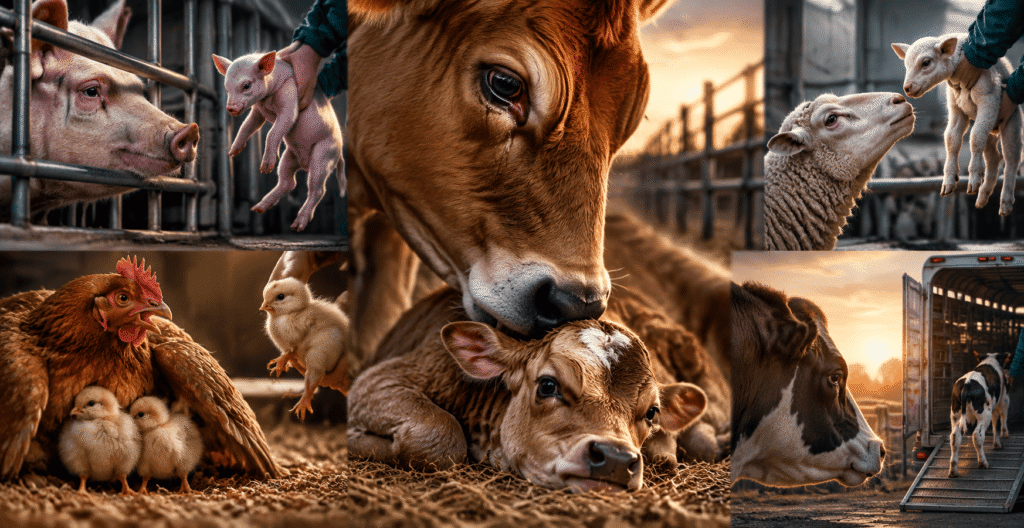
We celebrate motherhood excluding animal mothers. We admire a mother’s sacrifices, understand her labour pains, and recognise the unconditional love she has for her children. But when the mother belongs to another species, why does our compassion suddenly disappear?
When we see meat on our plates, we rarely think about the animal behind it. We hardly think about the mother who carried that life, went through pregnancy and childbirth, and may have been separated from her newborn.
Perhaps it is time we looked beyond the food on our plates and thought about the lives and suffering behind it.
Animals Also Experience the Pain of Motherhood
Many people think that giving birth is a simple and natural process for animals raised for meat. But is childbirth ever an easy experience?
Just like human mothers, cows, buffaloes, goats, sheep, pigs, and other mammals go through pregnancy and labour. Their bodies undergo physical changes, and childbirth can involve pain, exhaustion, complications, injuries, and even life-threatening situations.
Some animals need assistance during difficult deliveries. Others suffer from infections or complications after giving birth.
The fact that animals cannot explain their pain in words does not mean they do not experience it.
Pain is pain, regardless of which species experiences it.
A Mother’s Love Is Not Exclusive to Humans
Have we ever stopped to observe how an animal mother cares for her newborn?
A cow recognises and nurtures her calf. A goat feeds and protects her kid. A sheep cares for her lamb. These mothers groom their babies, provide nourishment, protect them from danger, and form emotional bonds with them.
These are natural maternal instincts.
Yet, in many animal farming systems, newborns are separated from their mothers, sometimes soon after birth.
Imagine a human mother carrying her baby for months, enduring the pain of childbirth, and then having her newborn taken away from her.
Imagine the distress of searching for her baby, calling out, and being unable to reach it.
Would we consider this a small matter?
Why, then, do we overlook the suffering of animal mothers?
Research and animal behaviour show that many animals experience stress and distress when separated from their young. Their suffering deserves our attention rather than being dismissed as an ordinary part of food production.
Why Do We Understand Human Mothers but Ignore Animal Mothers?
When a human mother gives birth, we understand that she needs care, rest, nourishment, and time to recover. We respect her pain and appreciate her sacrifices.
But when an animal mother goes through pregnancy, childbirth, and separation from her baby, we often consider it a normal part of the farming process.
Why this difference?
Is motherhood meaningful only when it belongs to humans?
Women who have experienced pregnancy and childbirth know how physically demanding and emotionally powerful motherhood can be. They understand the attachment a mother develops towards her child and the instinct to protect and nurture that child.
Shouldn’t this understanding help us feel compassion for mothers of other species too?
A mother’s feelings should not become less important simply because she cannot speak our language.
Behind Every Piece of Meat Is a Life
We usually see meat as a food product. We think about its taste, price, and preparation, but rarely about the life behind it.
We do not think about the mother who carried the animal, the newborn who depended on her, or the circumstances in which they were separated.
The distance between the living animal and the food on our plate makes it easier to forget the suffering involved.
But these animals are not machines created to produce meat and milk. They are living beings capable of experiencing pain, fear, stress, comfort, and attachment.
Their lives matter too.
Can We Make More Compassionate Choices?
The purpose of this discussion is not to blame or shame anyone. It is to encourage people to think, question old habits, and make more compassionate choices.
We can learn about where our food comes from, understand the suffering involved in animal agriculture, reduce our consumption of meat, and consider plant-based alternatives.
Even a small change in our food choices can be a step towards reducing animal suffering.
We often teach our children to love animals and respect mothers. Perhaps we should also teach them that motherhood and maternal instincts are not limited to humans.
A Final Thought: Compassion Should Have No Species Boundary
Imagine a mother who carries her baby for months, endures childbirth, feeds her newborn, and instinctively wants to protect and nurture her child.
Now imagine that same mother being treated merely as a source of milk or meat, with little consideration for her feelings or her relationship with her baby.
Would we accept this treatment if she were human?
Then why do we find it so easy to ignore when she is an animal?
We celebrate motherhood with beautiful words, but shouldn’t our actions reflect the same compassion?
A cow is also a mother. A goat is also a mother. A sheep is also a mother. Their love for their young may not look exactly like ours, but their maternal instincts and suffering are real.
Let us learn to see beyond our own species. Let us recognise the pain of animal mothers and question the choices that contribute to their suffering.
The next time we sit down for a meal, let us remember that behind the meat on our plates may be a mother who once carried a baby, nurtured it, and formed a bond with it.
Motherhood has no species boundary. Compassion should have none either.
Choose kindness. Rethink your food choices. Give every living being the consideration it deserves.